Welcome to the KisanHal Blog, your trusted source for practical farming tips, agriculture business ideas, modern farming techniques, and useful information for Indian farmers.
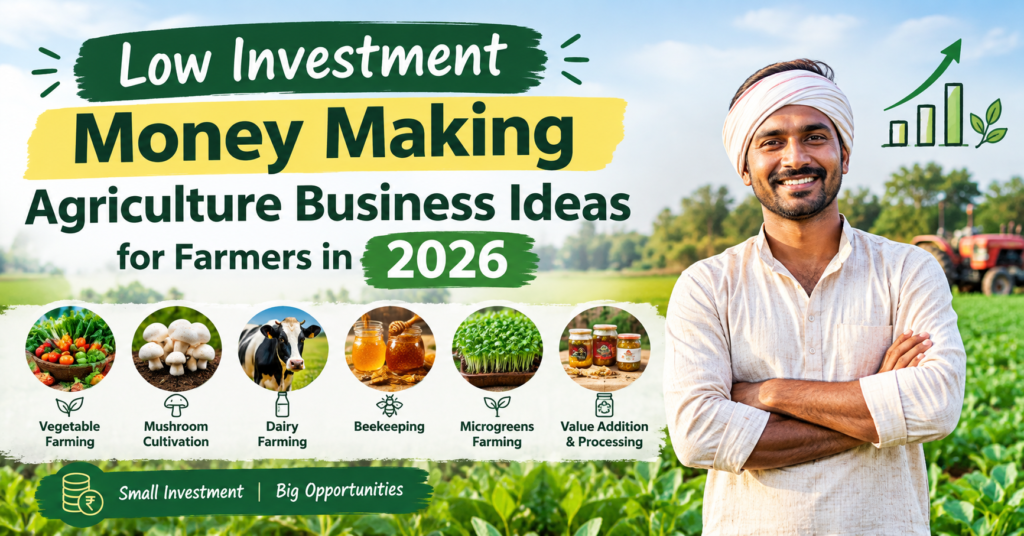
Agriculture is no longer limited to traditional crop farming. In 2026, farmers can explore several low investment agriculture business ideas that can generate additional income from available land, farm resources, livestock, and local market opportunities.
From mushroom farming and beekeeping to plant nurseries, poultry farming, dairy farming, and food processing, many agriculture-related businesses can be started on a small scale and expanded gradually.
The right business depends on factors such as available land, water supply, local demand, climate, skills, and budget. Before investing, farmers should study their local market and calculate expected costs, selling prices, and potential returns.
In this Blog, we explore some of the best low investment agriculture business ideas for farmers in 2026.
Best Low Investment Agriculture Business Ideas for Farmers in 2026
Here are some agriculture businesses that farmers can consider starting with relatively limited capital.
1. Mushroom Farming
Mushroom farming can be a suitable option for farmers who have limited land because it can be carried out in a controlled indoor environment.
Oyster mushroom and other varieties can be cultivated in suitable conditions using agricultural waste and locally available materials. Farmers can sell fresh mushrooms to local vegetable markets, restaurants, hotels, retailers, and consumers.
Why consider mushroom farming?
- Requires limited space
- Can be started on a small scale
- Uses agricultural waste as a growing medium
- Demand for mushrooms is increasing in many markets
- Multiple production cycles can be possible
However, temperature, humidity, hygiene, and disease management need to be carefully monitored.
2. Beekeeping and Honey Production
Beekeeping is another agriculture business that can be started with comparatively low land requirements.
Honeybees can provide honey and other products such as beeswax. Beekeeping can also support crop pollination, which may benefit farmers growing fruit, vegetable, and seed crops.
Farmers should select suitable bee species, understand colony management, and identify reliable buyers before starting.
Potential income sources include:
- Honey
- Beeswax
- Other bee products
- Pollination services in suitable agricultural areas
Starting with a small number of bee colonies can allow farmers to learn the business before expanding.
3. Plant Nursery Business
A plant nursery business can be a profitable option for farmers located near towns, cities, and areas with strong demand for plants.
Farmers can produce and sell vegetable seedlings, fruit plants, ornamental plants, medicinal plants, and other planting material depending on local demand.
A nursery can generate income from relatively small land areas when plants are properly managed.
Key advantages:
- Can be started on a small scale
- Multiple types of plants can be sold
- Demand can come from farmers, gardeners, landscapers, and households
- Production can be planned according to seasonal demand
Farmers should focus on healthy planting material, suitable varieties, proper irrigation, and good customer service.
4. Poultry Farming
Poultry farming is a well-known agriculture-related business that can provide regular income when managed properly.
Farmers can consider broiler farming for meat production or layer farming for egg production. The choice should depend on local demand, available infrastructure, feed costs, and the farmer’s experience.
Before starting a poultry farm, calculate the cost of:
- Chicks
- Poultry shed
- Feed
- Vaccination and veterinary care
- Electricity and water
- Labour
- Transportation
Farmers should also identify buyers and understand local poultry prices before making a major investment.
5. Small-Scale Dairy Farming
Dairy farming can provide farmers with a regular source of income through milk sales.
Instead of immediately starting a large dairy farm, farmers can begin with a small number of healthy animals and gradually expand the herd based on market demand and available resources.
Income may come from:
- Fresh milk
- Curd
- Paneer
- Ghee
- Other value-added dairy products
Proper animal nutrition, clean housing, veterinary care, and breed selection are important for dairy farming profitability.
6. Goat Farming
Goat farming can be considered by farmers who want to start a livestock business with limited space compared with larger livestock operations.
Goats can be raised for meat, breeding, and in some cases milk. Demand for goat meat is strong in many parts of India, but profitability depends on breed, feed costs, animal health, mortality rates, and selling prices.
Farmers should choose breeds suitable for their local climate and market rather than selecting a breed only because it is popular elsewhere.
7. Vermicompost Production
Vermicompost production converts organic waste into nutrient-rich compost using earthworms.
Farmers can use farm waste, crop residues, and other suitable organic materials to produce compost for their own fields or sell it to other farmers, nurseries, and gardeners.
Benefits of vermicompost production include:
- Relatively simple production process
- Can use locally available organic materials
- Requires comparatively little space
- Can create an additional income source
- Can complement organic and natural farming practices
Maintaining suitable moisture, temperature, and organic material is essential for good-quality vermicompost.
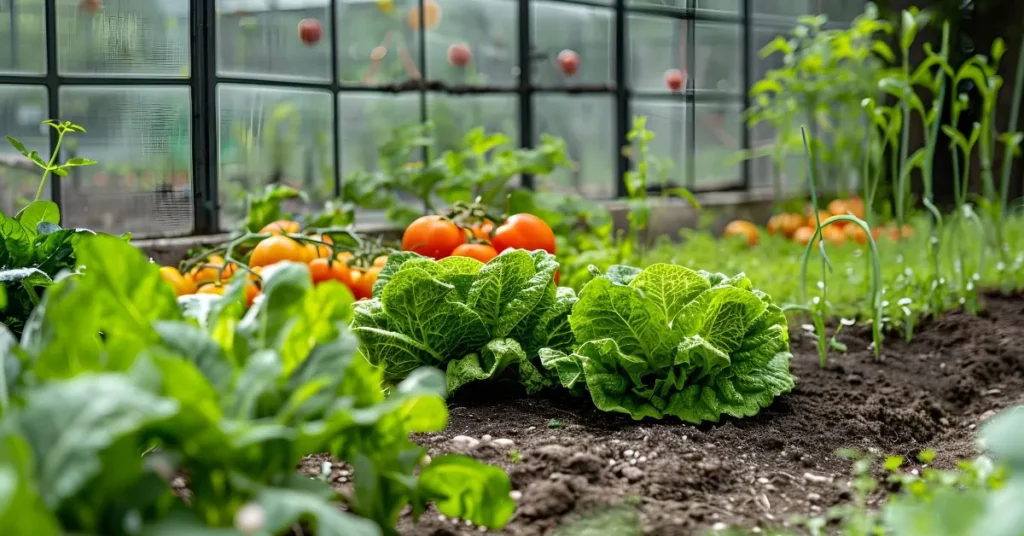
8. Vegetable Farming on a Small Scale
Farmers with suitable land and water availability can consider high-value vegetable farming.
Instead of focusing only on large-scale production, farmers can study local demand and select crops that have suitable growing conditions and better market opportunities.
Depending on the region, farmers may consider vegetables such as:
- Tomato
- Chilli
- Capsicum
- Cucumber
- Okra
- Leafy vegetables
- Seasonal vegetables
Direct selling to local consumers, retailers, restaurants, or local markets may provide better opportunities than depending on a single buyer.
9. Fruit Nursery and Orchard Business
Fruit plants can provide an opportunity for farmers who want to build a long-term agriculture business.
Farmers can establish nurseries for popular fruit plants or develop orchards according to their region and market demand.
Possible fruit crops vary by climate and location. Mango, guava, pomegranate, citrus, papaya, and other crops may be suitable in different regions.
Farmers should consider the crop’s gestation period, irrigation requirements, disease management, market demand, and expected selling price before investing.
10. Spice Cultivation
India has a strong market for spices, making spice cultivation another agriculture business opportunity.
Depending on the region and climate, farmers can explore crops such as chilli, turmeric, coriander, cumin, ginger, garlic, and other suitable spices.
Profitability can improve when farmers focus on quality, proper post-harvest handling, storage, grading, and better market access.
11. Flower Farming
Flower farming can be an attractive option in areas with suitable climate and access to nearby markets.
Flowers may be sold to wholesalers, retailers, event decorators, temples, florists, and other buyers.
Before starting commercial flower cultivation, farmers should study:
- Local flower demand
- Seasonal prices
- Transportation requirements
- Irrigation availability
- Storage and handling needs
- Nearby buyers
Because flowers can be highly perishable, market planning is particularly important.
12. Fish Farming
Farmers with suitable land and reliable water availability can consider fish farming.
A small pond can potentially be used for fish production after assessing soil, water quality, species suitability, infrastructure, and local market demand.
Farmers should not invest in pond construction or fish stocking without first understanding the technical requirements and expected operating costs.
13. Agricultural Equipment Rental Business
Farm machinery rental can be an interesting business opportunity in areas where many farmers need machines but cannot afford to purchase them individually.
Farmers or rural entrepreneurs can consider renting suitable equipment such as:
- Power Weeder
- Brush Cutter
- Sprayer
- Water Pump
- Tiller
- Agricultural implements
The business model can work by charging customers according to hours, days, acreage, or specific farm operations.
Before purchasing equipment, study local demand, machine utilization, maintenance costs, fuel or electricity expenses, transportation, and seasonal demand.
14. Farm Produce Processing and Value Addition
Selling raw agricultural produce is not the only way to earn from farming. Value addition can help farmers explore additional revenue opportunities.
For example, farmers can process suitable crops into products such as:
- Pickles
- Spices
- Flour
- Dehydrated vegetables
- Papad
- Jams
- Other locally demanded food products
The investment depends heavily on the product, processing equipment, packaging, food-safety requirements, and scale of operation.
Farmers should start with products that have proven demand in their local market rather than producing large quantities without a sales plan.
15. Agri-Input Shop
Farmers or rural entrepreneurs with suitable knowledge and business planning can consider an agriculture input business.
Depending on applicable regulations and licensing requirements, an agri-input store may sell products and supplies needed by local farmers.
Possible product categories can include:
- Seeds
- Fertilizers
- Irrigation products
- Farm tools
- Agricultural equipment
- Other farming supplies
Location is especially important because an agri-input shop should ideally be accessible to farmers in nearby villages and farming areas.
How to Choose the Right Agriculture Business
Not every agriculture business is suitable for every farmer. Before investing money, consider these factors.
1. Start With Your Budget
Calculate how much money you can invest without creating unnecessary financial pressure.
Divide your investment into:
Initial Investment + Working Capital + Emergency Reserve
Do not spend the entire budget on infrastructure or equipment.
2. Check Local Market Demand
A business is easier to operate when there is a clear market for the product.
Talk to local buyers, wholesalers, retailers, restaurants, farmers, and consumers before starting.
3. Consider Your Land and Resources
Check the availability of:
- Land
- Water
- Electricity
- Labour
- Storage
- Transportation
Choose a business that matches the resources you already have.
4. Understand the Production Cycle
Some businesses generate income quickly, while others require months or years.
For example, mushroom farming may have a shorter production cycle, while an orchard may require a longer waiting period.
Understanding the cash-flow cycle is important before investing.
5. Start Small and Scale Gradually
One of the safest approaches for a new agriculture entrepreneur is to start with a manageable scale.
Test your production process and market first. Once you understand the costs and sales process, expand gradually.
How to Increase Profit From an Agriculture Business
Starting a business is only the first step. Farmers can improve profitability by focusing on production efficiency and market access.
Reduce Unnecessary Costs
Track spending on feed, fertilizer, labour, electricity, transportation, packaging, and other inputs.
Improve Product Quality
Better-quality produce and processed products can help build repeat customers.
Explore Direct Selling
Where practical, selling directly to consumers, retailers, restaurants, or institutional buyers can reduce dependence on intermediaries.
Use Digital Marketing
Farmers and rural entrepreneurs can use WhatsApp, social media, Google Business Profile, and local online marketplaces to reach potential customers.
Add Value to Farm Produce
Processing, packaging, grading, and branding can create additional opportunities compared with selling raw produce alone.
Government Schemes and Financial Support
Before starting an agriculture business, farmers should also check the latest government schemes, subsidies, training programs, loans, and other support available for their specific business and state.
Eligibility, subsidy amounts, application processes, and scheme guidelines can change, so farmers should verify the latest information through official government sources or relevant departments before making financial decisions.
Common Mistakes to Avoid
Farmers should avoid these common mistakes when starting a new agriculture business:
- Investing without researching local demand
- Choosing a business only because someone else is making money from it
- Ignoring working capital requirements
- Underestimating transportation and marketing costs
- Starting at a large scale without testing the market
- Not maintaining production and expense records
- Ignoring animal, crop, or product quality
- Depending on only one buyer
Which Agriculture Business Is Best for Low Investment?
There is no single agriculture business that is best for every farmer.
For farmers with limited land, mushroom farming, beekeeping, vermicompost production, and plant nurseries may be worth exploring.
Farmers with livestock experience may consider dairy, goat, or poultry farming.
Those with suitable land and water may explore vegetable farming, fish farming, or flower cultivation.
Farmers who want to build a business around machinery can explore agricultural equipment rental, while those with access to raw materials and local markets can consider food processing and value addition.
The best option depends on investment capacity, local demand, available resources, technical knowledge, and market access.
Conclusion
The agriculture sector offers many opportunities beyond traditional crop farming. In 2026, farmers can explore low investment agriculture business ideas that use existing farm resources while creating additional sources of income.
Mushroom farming, beekeeping, plant nurseries, poultry, dairy, goat farming, vermicompost, vegetable cultivation, agricultural equipment rental, and value-added food businesses are some options worth evaluating.
However, profitability should never be assumed. Before investing, conduct local market research, calculate the complete cost of the business, understand the production cycle, and identify potential buyers.
Start small, understand your market, control your costs, and scale the business based on actual results.